


Faculty & Research

Faculty & Research
The World Cup Paradox: How China can win global influence without winning on the pitch

By Bala Ramasamy
As the 2026 FIFA World Cup—hosted across the United States, Canada, and Mexico—approaches, global attention is once again turning to the intersection of sport, economics, and geopolitics. Beyond the excitement on the pitch, mega sporting events have become powerful platforms for national branding and soft power projection.
For China, whose economic and political influence continues to expand globally despite limited success in football, the World Cup raises an important strategic question: how can a nation shape global narratives through sport, even without competing on the field?
Drawing on data and international case studies, CEIBS Professor of Economics, Associate Dean and Director of Global EMBA Programme Bala Ramasamy explores how sport functions as a modern arena of soft power, and what it reveals about China’s evolving role in the global sporting ecosystem.
Introduction: The Spectacle of Power
Sports has always been a theatre for the performance of national identity and a proxy for the competition of systems, both economic and political. As the2026 FIFA’s World Cup Football begins, hosted jointly by Canada, Mexico and the United States, it revives a question that resonates strongly in China: why has a country with such a large population, resources, talent and technology, remained largely absent from football’s biggest stage (except in 2002), despite being a major economic and political power? This in turn raises a broader question: does geopolitical and economic power naturally translate into sporting success?
The question is no longer whether sport and power are linked, but how they are linked. This article addresses two interconnected questions: first, how do events like the FIFA World Cup and the Olympic Games contribute to national soft power; and second, what lessons can China draw from global case studies in using sport for cultural diplomacy? My central argument is that the link between being a sporting superpower and a political one is real but conditional, and that China's path to influence through sport lies not in replicating Western models of athletic dominance, but in mastering the art of the event itself.
The Scoreboard of Nations: Olympic Medals as an Index of State Capacity
The most empirically robust link between sport and geopolitical power is found in the Olympic medal table. It is not a perfect mirror, but a powerful index of the underlying components of national strength. Economists have repeatedly demonstrated that a nation's Olympic medal haul is highly predictable using a limited set of macro-level variables: total GDP, population size, and host-nation status. The data from the recent Tokyo 2020 and Paris 2024 Olympics provides a simple illustration of this link.
Table 1: Tokyo 2020 Olympic Medal Table (Top 6) vs. National Power Indicators
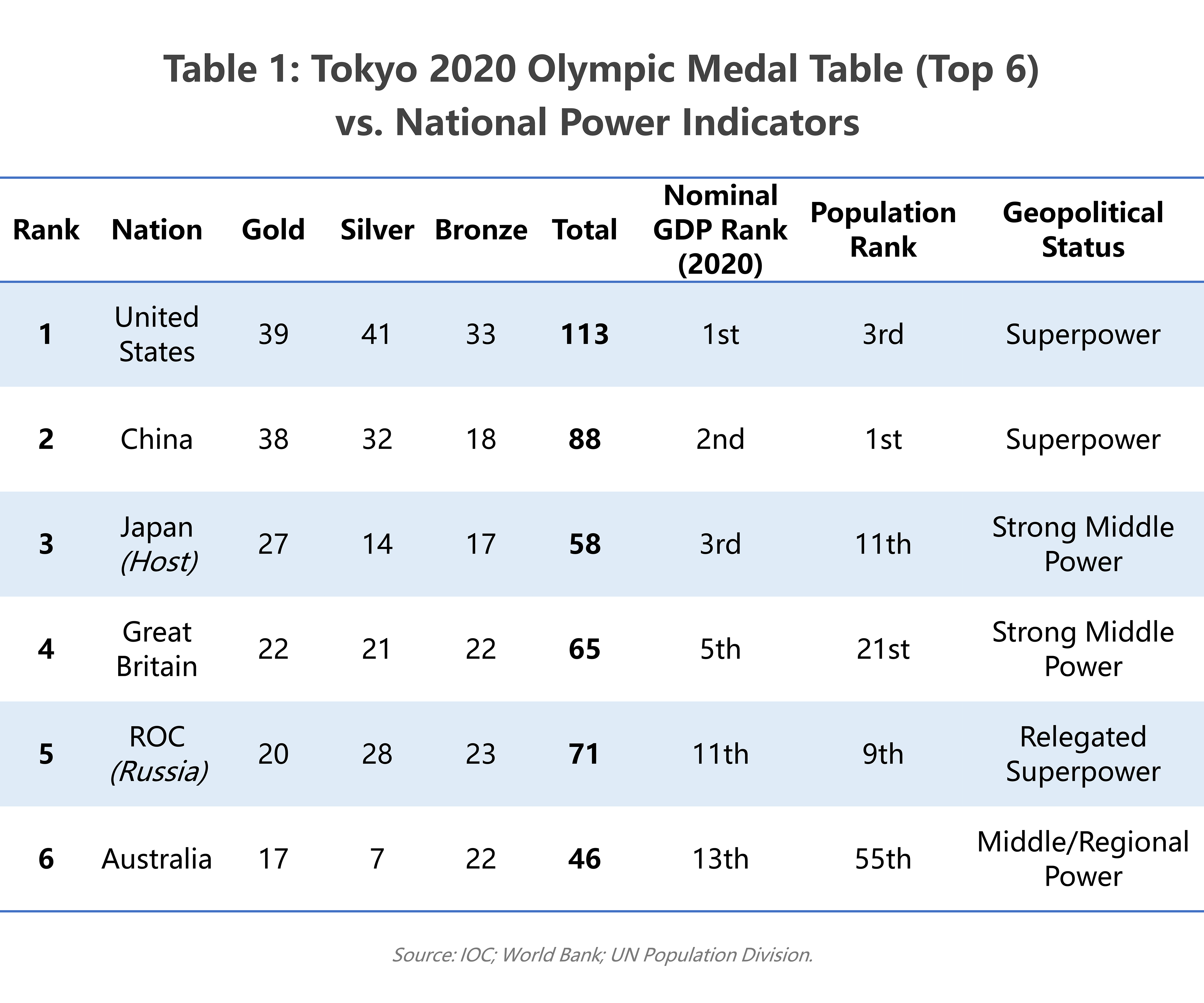
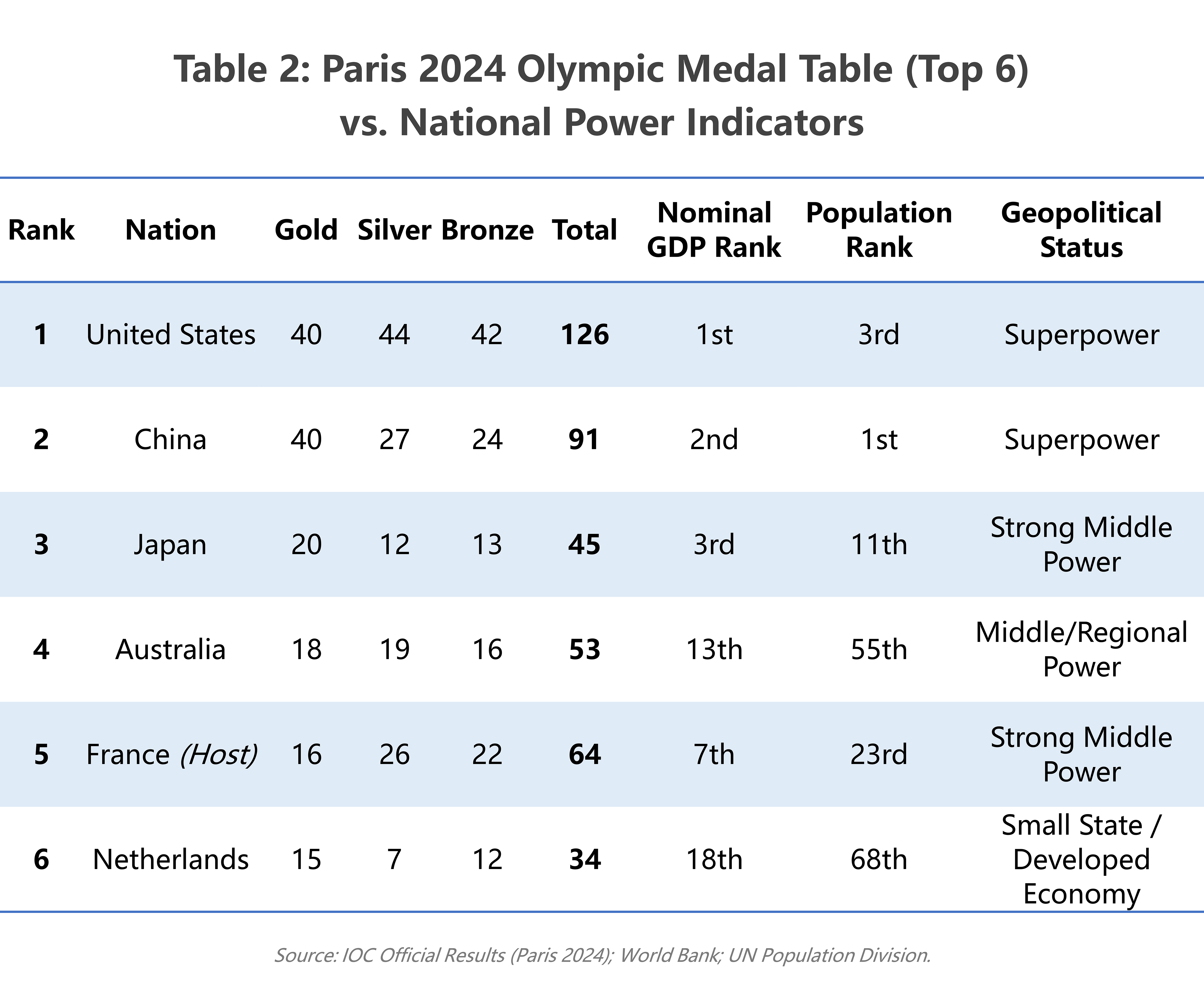
The pattern is striking. At the top of the medal table sits a near-perfect reflection of the geopolitical hierarchy. The United States and China, the world's two largest economies and preeminent global rivals, occupy the top two spots. This is a stark reflection of their economic might, vast talent pools, and institutional capacity to fund and organise a broad, diversified sports programme.
Australia's presence as an "overperformer"—a nation of only 26 million with a global GDP ranking of 13th finishing 6th and 4th in total medals, respectively—is the exception that proves the rule, demonstrating how a high-capacity middle or regional power can maximise its potential through focused investment. The causal arrow here runs decisively from power to medals. The Olympic medal table is not a scoreboard of a single passion, but a comprehensive audit of a nation-state's ability to manage complexity.
The World Cup Paradox: When Power Does Not Translate into Performance
If the Olympics are an economist's dream example of this phenomenon, the FIFA World Cup is their nightmare. The statistical link between footballing success and national power, as measured by FIFA ranking or World Cup victories, is weak and unreliable. This is the foundational empirical truth for understanding the limits of the power-sport nexus.
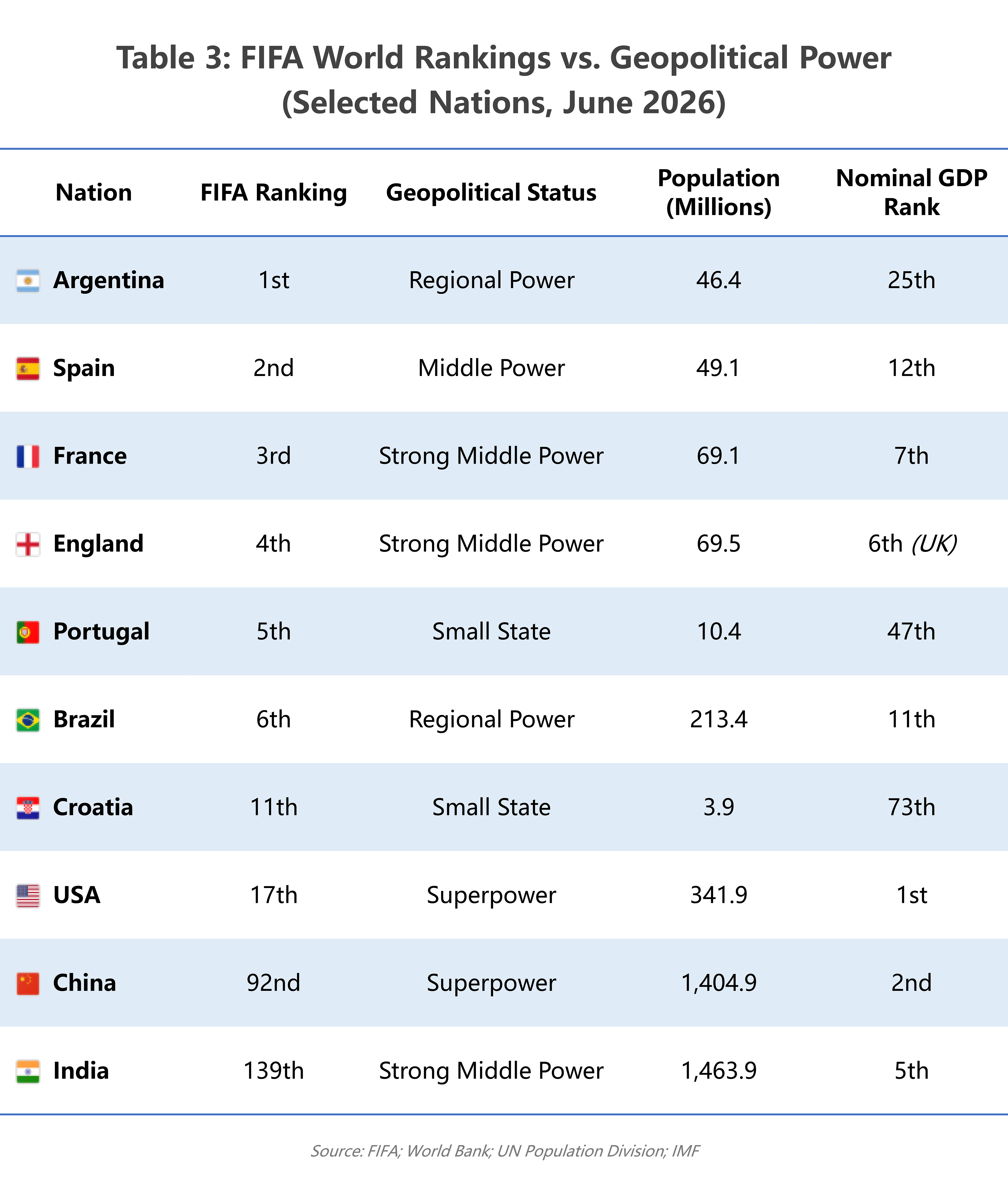
The contrast is striking from a traditional power perspective. Argentina and Brazil, regional powers whose geopolitical weight has never matched their footballing dominance, sit comfortably at the top alongside France. Portugal, a nation of only ten million people, ranks in the top five globally, while the world's two most populous nations, China and India, languish outside the top 90.
This disconnect exists because success in a single sport is governed by a fundamentally different equation than broad national power. The World Cup is not a system audit but a single-domain cultural expression, driven by cultural obsession and systemic focus, not total GDP.
The same principle extends to other single sports. The Olympic medal table, when disaggregated, reveals dozens of micro-dominions that decouple sporting power from geopolitical power. Table 4 illustrates this fragmentation using data from the Tokyo 2020 and Paris 2024 Games.
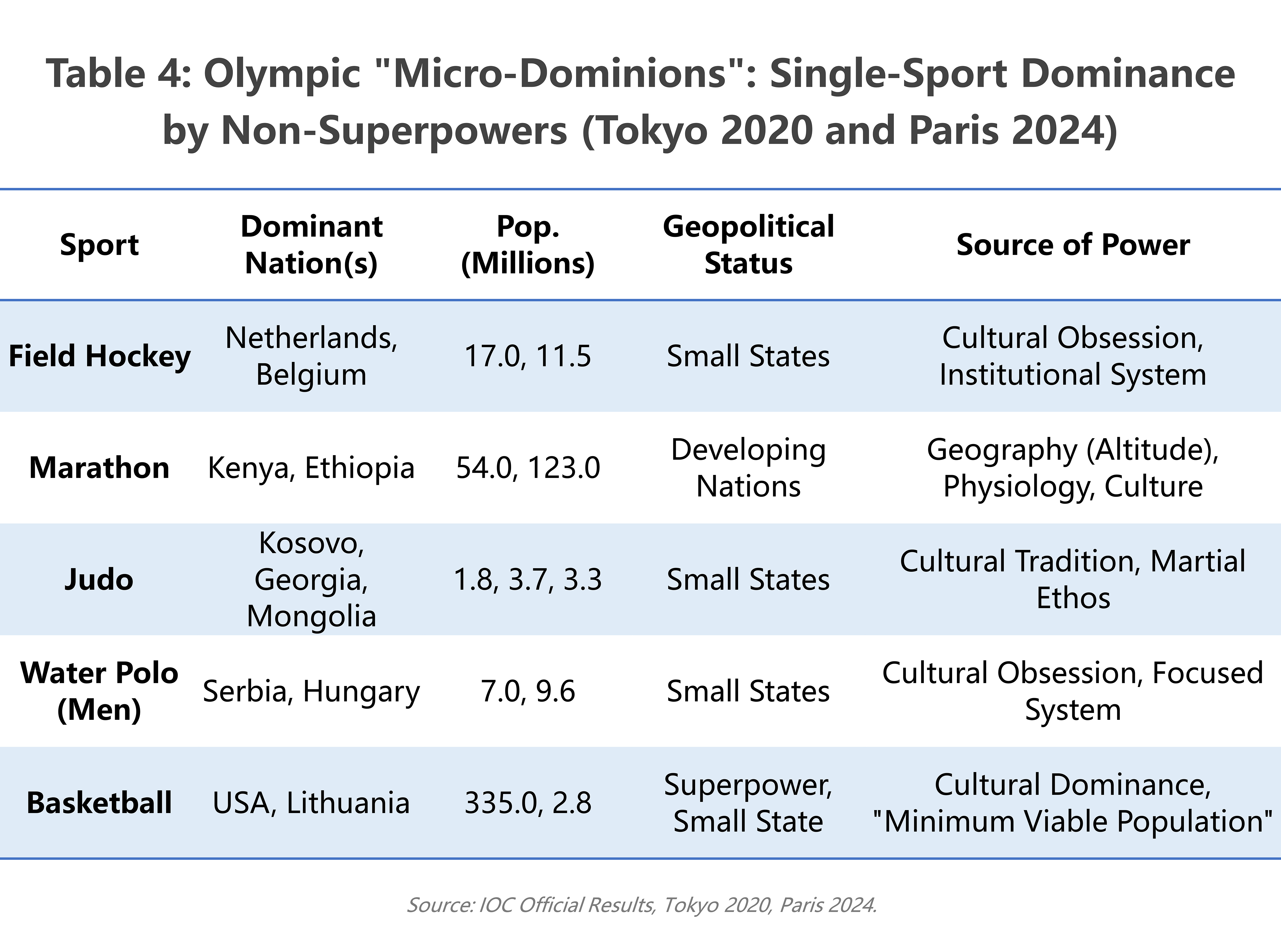
These are not exceptions; they are proof that being a "sporting superpower" is not a monolith. It is possible to be a total hegemon in a specific cultural niche—a "micro-superpower"—without possessing the broad institutional capacity of a great power. The soft power earned is real but domain-specific.
The Host's Catapult: How Events, Not Just Medals, Build Influence
If winning a World Cup is an unreliable tool of statecraft, hosting it is far more powerful. The primary mechanism for converting sport into geopolitical influence is not athletic victory, but the act of staging the spectacle itself. A mega-event acts as a high-stakes signal amplifier for a nation's trajectory, showcasing infrastructure, governance capacity, and cultural identity to a global audience. The historical record, however, is a checkered one of spectacular successes and perhaps, catastrophic failures.
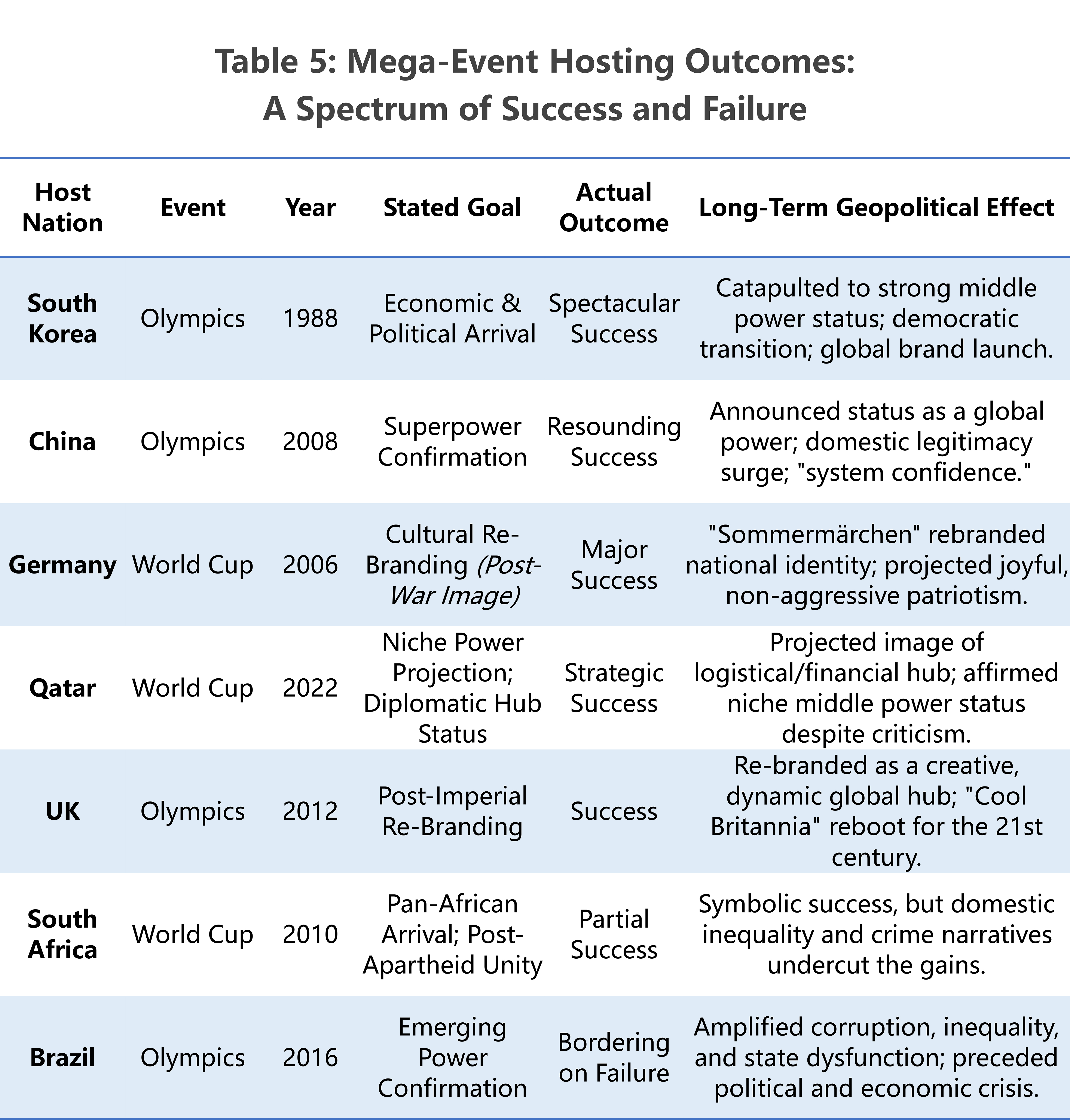
These cases demonstrate a clear strategic logic. A mega-event does not create new national power; it reveals and amplifies what already exists. The successful hosts used the event as a catalyst for institutional modernisation and a globally televised re-branding campaign. The failures saw their internal contradictions and state weaknesses broadcast to an audience of billions.
A Strategic Framework for Sports Soft Power
The various outcomes of global sporting engagement can be mapped into a strategic matrix defined by two variables. These core variables are scope of sporting ambition (niche-sport focus vs. comprehensive portfolio, eg. World Cup vs. Olympics) and mode of engagement (athletic participation vs. hosting/system-building). This creates four distinct strategic orientations for projecting soft power through sport.
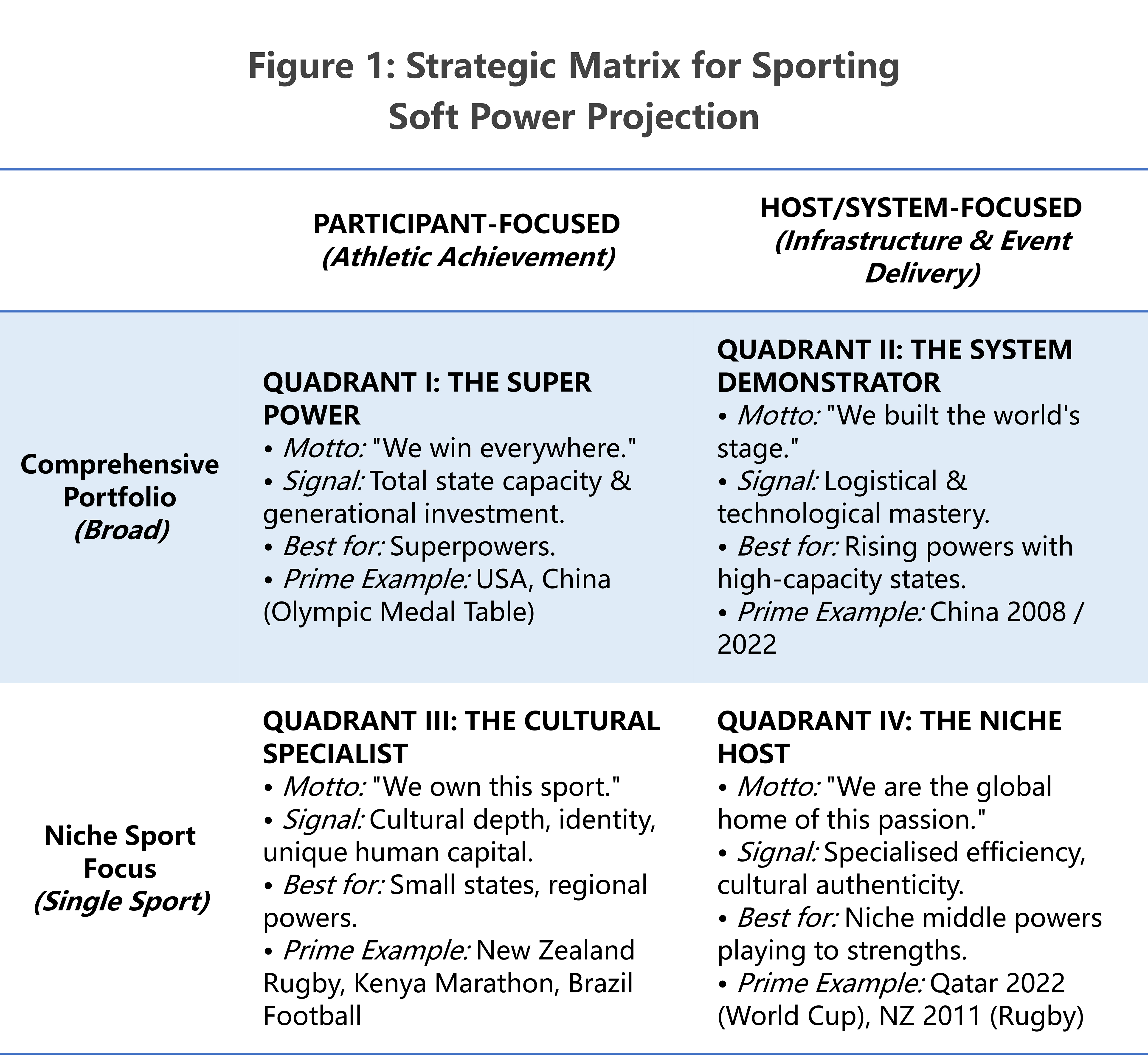
This matrix provides a powerful diagnostic tool. For decades, the United States and China have competed directly in Quadrant I, using the comprehensive Olympic portfolio to signal systemic state capacity. Small nations and regional powers like New Zealand and Brazil have maximised their influence through Quadrant III, building global brands from a specific cultural obsession. Germany in 2006 and Qatar in 2022 executed brilliant strategies in Quadrant IV, using a single-sport event for a specialised re-branding mission, bypassing the comprehensive demands of an Olympics.
For China, the matrix clarifies a strategic choice. The nation has already mastered Quadrant I and successfully executed in Quadrant II with the 2008 Olympics. Its footballing absence makes Quadrant III unattainable in the short term. The strategic opportunity, therefore, lies in an ambitious play for Quadrant IV on a single-sport stage—a synthesis of its system-demonstration capacity with the global platform of the World Cup.
Lessons for China: Redefining Power Through Technological Spectacle
This global landscape and strategic framework provide a clear roadmap for China. The first, crucial lesson is a corrective to a flawed premise: China's failure to qualify for the World Cup is not a symbol of national weakness. Table 3 makes this empirically undeniable. To doubt the status of China as a superpower because it failed to qualify for the World Cup is to misunderstand the nature of the link between power and spot. China's power is confirmed by its position at the apex of the Olympic medal table (Tables 1 and 2), a far more comprehensive validation of state capacity.
However, this absence creates a unique strategic problem: how does China project influence through a global event it is not competing in? The answer, derived from the matrix in Figure 1, lies in a bold synthesis: an ambitious play for Quadrant IV using the World Cup as the single-sport platform.
The lessons from the US, Europe, and the Middle East converge on a single point: the future of sporting soft power is technological and infrastructural. From the US, the lesson is the commercial and technological ecosystem. The American model is market-driven, powered by innovation from companies that dominate the fan experience and broadcast infrastructure. Its soft power is projected not just by athletes, but by its technology firms.
From Europe, specifically Germany 2006, the lesson is the power of cultural narrative: a sporting event can be a canvas for telling a new story about national identity—warm, modern, and confident—without militaristic or overtly political overtones.
From the Middle East, Qatar 2022 demonstrated the power of infrastructural ambition as statecraft, showing that a nation can be central to a sporting narrative not by winning, but by building the most technologically advanced stage in history.
For China, the synthesis of these lessons is clear. A future Chinese World Cup bid should not be premised on a hope that the national team might miraculously compete. It should be built around the explicit, confident offer of a technological and infrastructural spectacle. China can leverage the World Cup to tell a parallel story of power, one that states: "We may not be on the pitch, but we built this. This stadium, this high-speed rail network, this seamless, AI-driven security and fan experience system—this is the visible proof of our civilisational competence and our claim to leadership in the industries of the future." This reframes absence not as a humiliation, but as a strategic choice to compete in a different, potentially more impactful, arena of the same event. The power is projected not through the athletes, but through the systems that make their performance visible to billions.
Conclusion: From Playing the Game to Defining the Arena
The link between sporting superpower status and geopolitical power is real, but hierarchical. At the broad, Olympics level, medals are a credible index that mirror the state's capacity for complex, long-term organisation, while football reflects a unique alchemy of culture and focus, a realm where small nations can be titans and where China's absence signifies little about its geopolitical standing.
The primary strategic value of sport for a power like China therefore lies not in the unreliable pursuit of a World Cup trophy, but in the controllable, state-directed project of hosting the event itself. By synthesising the American model of commercial and technological integration, the European model of cultural re-branding, and the Middle Eastern model of infrastructural showmanship, China can redefine the game.
The shift is therefore from participant to architect—from competing on the field to designing the arena. The ultimate lesson is this: in the 21st century, the most powerful nation on the pitch may be the one that built it.
Bala Ramasamy is Professor of Economics, Associate Dean and Director of GEMBA Program at CEIBS. His research interest focuses on Asian economies, Foreign Direct Investment, Corporate Social Responsibility and International Business Strategy.