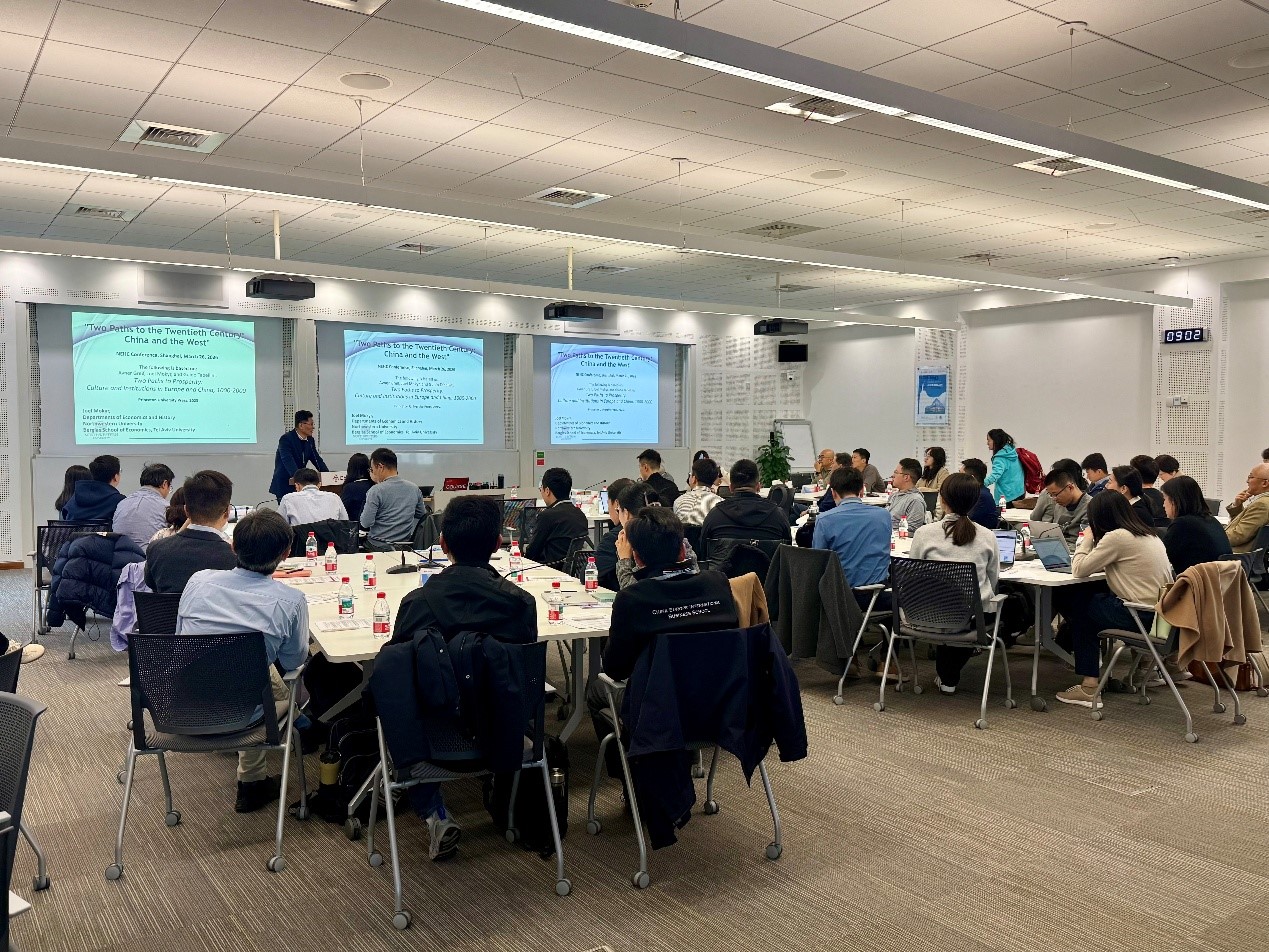



3rd Conference on New Economic History of China & 2026 CEIBS Economics Symposium Held
Shanghai, March 26-27, 2026 — The 3rd Conference on New Economic History of China and 2026 CEIBS Economics Symposium was held at the CEIBS Shanghai campus today. Jointly organised by the CEIBS Department of Economics and Decision Sciences and the CEIBS Research Area of China and the World, co-organised with the National University of Singapore (NUS) and Hong Kong Baptist University (HKBU), this one-and-a-half-day academic gathering continued CEIBS’ legacy of high-level intellectual exchange. Under the theme Understanding China: The Past as a Guide for the Future, the conference brought together leading global scholars to explore long-term economic development, institutional evolution, state capacity, and historical drivers of modern growth.
Held at the Duan Yongping Academic Centre, the symposium opened with remarks from CEIBS Vice President and Co-Dean Zhu Tian and featured keynote addresses, distinguished lectures, six research sessions, and a special concluding session, with in-depth presentations and discussions on frontier research in new economic history.
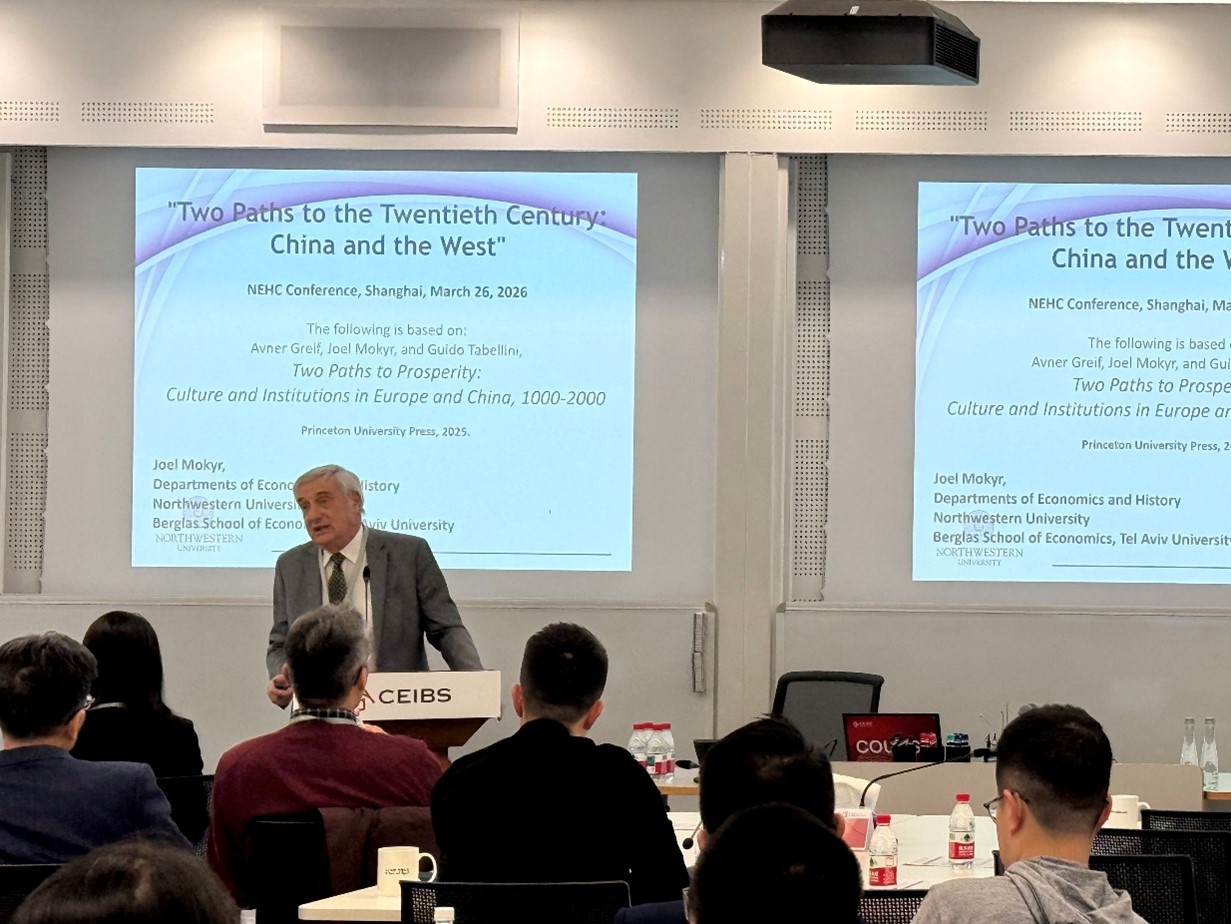
Keynote Address
Speaker: Prof. Joel Mokyr (Northwestern University), 2025 Nobel Laureate in Economic Sciences
Title: Two Paths to Prosperity: Culture and Institutions in Europe and China, 1000–2000
This presentation compared the cultural and institutional foundations of long term prosperity across Europe and China over the past millennium, exploring how different historical trajectories shaped modern economic outcomes.
Session 1 Chair: Prof. Xi Tianyang (Peking University)
- Prof. Erik Wang (New York University)
Title: The Breakdown of Credible Power-Sharing: Evidence from China under the KMT
This study examines why credible power sharing arrangements collapse. It argues that a sharp decline in a senior leader’s health can destabilise elite coalitions by weakening expectations of future patronage protection. Using the 1935 assassination attempt on Wang Jingwei as an example of an exogenous shock, the paper shows that Wang’s associates were far more likely to exit government, with stronger effects among officials with better private-sector options.
- Prof. Ma Chicheng (The University of Hong Kong)
Title: Distance to Bacon: The Search for the Culture of Growth in Historical China
Using semantic analysis of 861 Chinese intellectuals’ writings, this paper measures ideological proximity to Baconian Enlightenment ideals. It finds that Chinese thought lagged in progress, pluralism, and experimental methods before 1842, but rapidly converged after the opening of the country, especially among intellectuals exposed to modern learning and broad international experience.
Session 2 Chair: Prof. Li Peiyuan (Duke Kunshan University)
- Prof. Liu Cong (Jinan University)
Title: Crises and Career Choices: Evidence from Overseas Chinese Students during the Great Depression
Based on 3,359 STEM returnees to Republican China, this study uses difference-in-differences to show that the Great Depression pushed US educated students toward public sector careers. Mechanism evidence links this shift to ideological attraction to the welfare state amid crisis.
- Prof. Zhao Yiling (Peking University)
Title: Shifting Standards: The Military Examination System and Official Selection in Qing China
Analysing 17,528 military exam graduates across the Qing Dynasty, this paper documents a shift from balanced emphasis on martial skills and literary talent to exclusive focus on martial skills during the Jiaqing reign. This change reshaped military official composition and long run promotion paths, with lasting impacts on Qing military capacity.
Session 3 Chair: Prof. Duan Li (Shanghai University of Finance and Economics)
- Prof. Joy Chen (Renmin University)
Title: Agricultural Productivity and State-Building: Evidence from the Iron Revolution in Pre-Imperial China
This study links the iron agricultural revolution to state-formation in the Eastern Zhou dynasty. Greater iron access raised agricultural productivity and state extraction incentives, driving more intensive state-building—supporting a productivity based mechanism complementary to military-conflict theories.
- Prof. Carol Shiue (University of Colorado Boulder)
Title: Mining Chinese Historical Sources at Scale: A Machine Learning Approach to Qing State Capacity
Using machine learning on China’s Qing Shilu (Veritable Records), this paper extracts and classifies social unrest records to analyse Qing state perceptions of legitimacy threats. Distinguishing peasant, militia, and secret society uprisings yields new measurements of state capacity and governance priorities.
Session 4 Chair: Prof. Xu Zhihao (Tsinghua University)
Distinguished Address
Speaker: Prof. James Kung (The University of Melbourne)
Title: Out with Keju, In with “Useful Knowledge”: The Emergence of Modern Occupations in Dynastic China
This address analysed how the abolition of the imperial examination system accelerated the rise of modern occupations and practical knowledge systems, reshaping China’s human capital and professional structure.
Session 5 Chair: Prof. Gao Pei (National University of Singapore)
Distinguished Address
Speaker: Prof. Li Bozhong (Peking University)
Title: Transport and Market: The Driving Forces of China's Long 18th Century Prosperity
This presentation highlighted transport infrastructure and market integration as core engines of China’s economic dynamism during the long 18th century, revealing historical foundations of commercial growth.
Session 6 Chair: Prof. Diao Wentian (Shanghai University of Finance and Economics)
- Prof. Clair Yang (University of Washington in Seattle)
Title: A Theory of Political Divergence and Gradual Institutional Change
This paper develops a formal theory of co evolution between political institutions and social structures. It shows how short-run coalitions and policies generate long run divergence in development paths, illustrated by medieval Europe, imperial China, and the Islamic world.
- Prof. John Quah (National University of Singapore)
Title: A Theory of Aristocracy
This study frames aristocracy as a loyalty-talent trade-off in governance. Rulers relied on aristocratic tenure where monitoring was difficult, while literacy and bureaucratic capacity enabled transitions to merit-based bureaucracy. The theory explains historical patterns of state bureaucratisation, with special focus on early modern China.
Special Session and Closing Remarks
Speaker: Prof. Zhao Dingxin (University of Chicago and Zhejiang University)
Title: Market Scale versus Merchant Power in Early Modern China and Europe: Prosperity, Politics, and the Limits of Commercial Wealth
This session compared market scale and merchant influence across early modern China and Europe, debating their roles in prosperity, political order, and the constraints on commercial power.
The conference closed with remarks by Prof. Che Jiahua (CEIBS) and Prof. Tuan-Hwee Sng (National University of Singapore), summarising key insights and affirming the value of historical inquiry for understanding contemporary economic challenges.